
30 seconds · P04 cross-stack
TetherMem transfers to the Deep-Forcing attention stack.
This matched comparison isolates the routing intervention on Deep-Forcing. The outputs remain close overall, demonstrating cross-stack compatibility.
HUST×Long-horizon autoregressive video generation
Query-aware memory routing preserves identity-bearing history while allowing backgrounds, viewpoints, and scene states to keep evolving.
Training-free · frozen video generator · inference-time intervention
See the effect first
Four matched 30-second comparisons expose distinct long-horizon behaviors. Each case is pre-aligned into one side-by-side video, so a single playback control moves both methods through the same moment.
30 seconds · P04 cross-stack
This matched comparison isolates the routing intervention on Deep-Forcing. The outputs remain close overall, demonstrating cross-stack compatibility.
30 seconds · P07 flower vendor
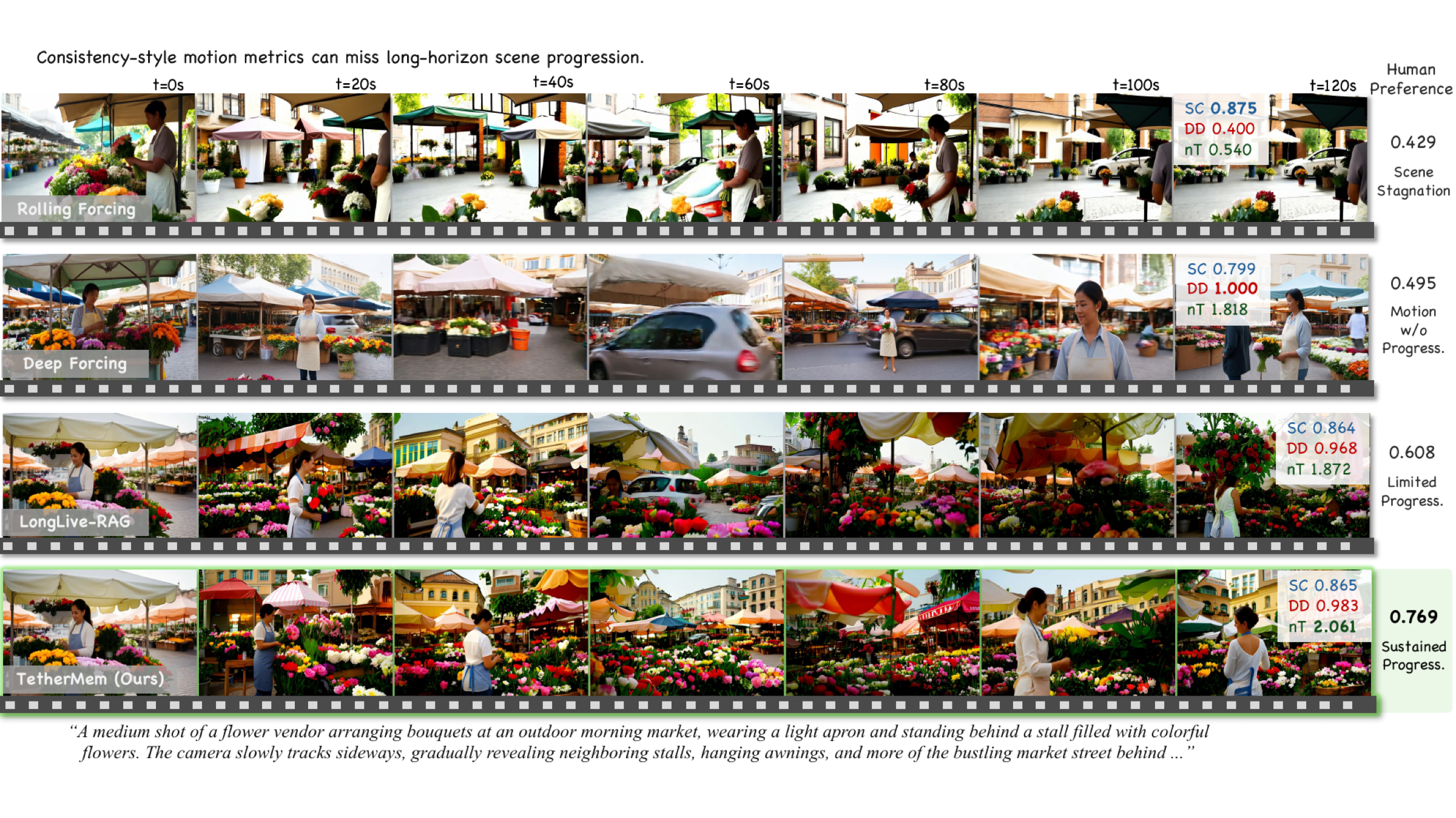
Rolling-Forcing stays close to the opening flower stall. TetherMem reveals new stalls, pedestrians, and street context while keeping the vendor identifiable.
30 seconds · P01 fisherman harbor
The videos share the P01 prompt and seed. Causal-Forcing darkens and loses scene detail in the later window; TetherMem retains the fisherman, his action, and the evolving harbor.
30 seconds · P03 dog in park
This matched static-camera case separates subject continuity from uncontrolled scale drift. TetherMem preserves the dog while introducing new, coherent park context.
Table 1 · Main comparison
Human expected preference measures the complete 30-second experience. Short-clip quality, motion, and VBench diagnostics remain visible beside it, so identity retention cannot be mistaken for scene progression.
| Method | 5s | 30s human EP ↑ | Diag. | VBench ↑ | ||||||
|---|---|---|---|---|---|---|---|---|---|---|
| Img5 ↑ | Ovr. | Prog. | ID | L1 | nT ↑ | Subj. | Back. | Smooth. | Dyn. | |
| Base model · non-autoregressive | ||||||||||
| Wan2.1-T2V-1.3B | 65.6 | — | — | — | — | 0.322 | — | — | — | — |
| Long-memory / retrieval | ||||||||||
| LongLive-RAG | 71.0 | 0.615 | 0.608 | 0.507 | 0.587 | 0.868 | 0.861 | 0.897 | 0.973 | 0.867 |
| Forcing-based generation | ||||||||||
| Self Forcing | 70.5 | 0.320 | 0.356 | 0.437 | 0.273 | 0.192 | 0.885 | 0.907 | 0.983 | 0.767 |
| Rolling Forcing | 72.2 | 0.553 | 0.429 | 0.633 | 0.651 | 0.040 | 0.933 | 0.935 | 0.985 | 0.433 |
| Deep Forcing | 70.5 | 0.526 | 0.495 | 0.531 | 0.508 | 0.350 | 0.899 | 0.916 | 0.983 | 0.800 |
| Causal Forcing | 70.2 | 0.210 | 0.440 | 0.285 | 0.158 | 1.226 | 0.824 | 0.873 | 0.973 | 0.867 |
| Reward Forcing | 69.3 | 0.573 | 0.530 | 0.487 | 0.620 | 0.366 | 0.903 | 0.927 | 0.985 | 0.733 |
| Memory / positional methods | ||||||||||
| MemRoPE | 72.1 | 0.640 | 0.578 | 0.559 | 0.666 | 0.551 | 0.892 | 0.908 | 0.986 | 0.700 |
| CausVid | 65.9 | 0.283 | 0.295 | 0.461 | 0.328 | 0.190 | 0.879 | 0.896 | 0.982 | 0.767 |
| Spatiotemporal memory routing | ||||||||||
| TetherMem Ours | 71.1 | 0.780 | 0.769 | 0.600 | 0.708 | 1.289 | 0.855 | 0.895 | 0.973 | 0.867 |
The problem
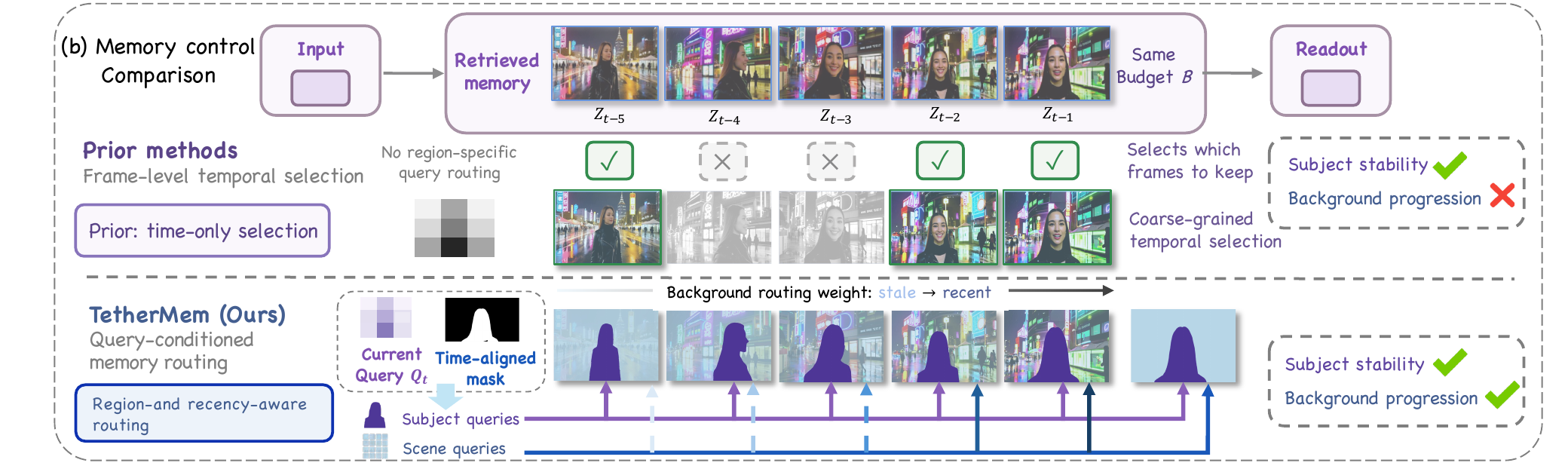
Subject identity needs long-range access. Scene progression needs recency. Applying one frame-level memory policy to both creates the familiar identity–progression trade-off.
A short rolling context can preserve local continuity while repeatedly returning to the opening view.
Failure · stagnationLong-range motion can continue even as spatial detail and trajectory coherence deteriorate.
Failure · incoherent motionFrame-level retrieval gives subject and scene queries the same historical context, limiting progression.
Failure · shared policyQuery-aware routing keeps identity-bearing history available while scene queries favor recent states.
Route · subject ≠ scene
Method
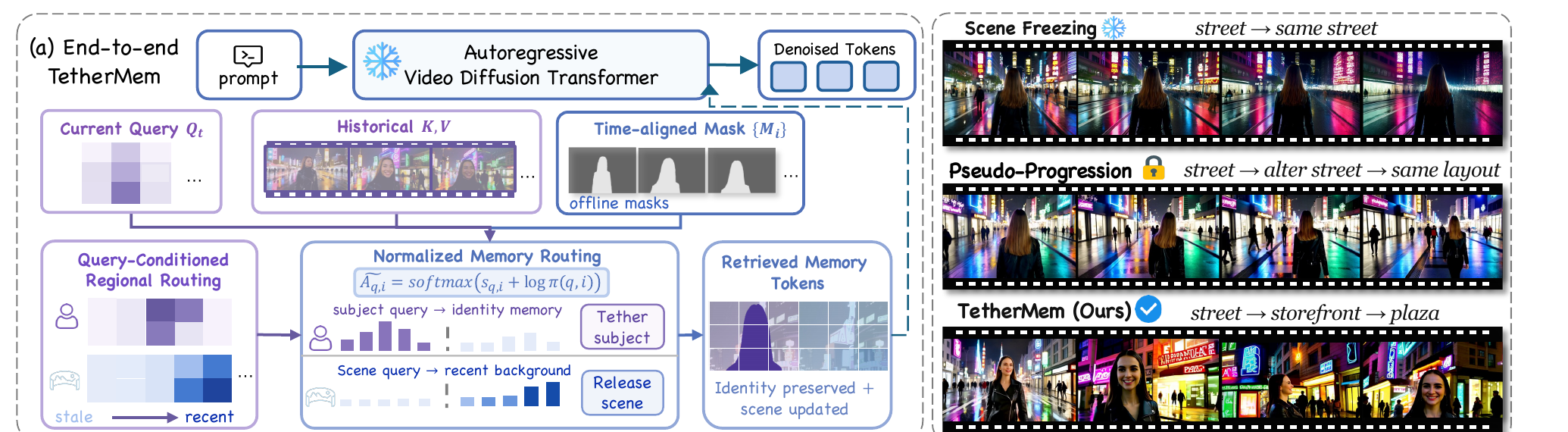
TetherMem places a positive spatiotemporal routing prior inside attention normalization. Switch the query below to see how the same retrieved memory is read differently.
The prior changes selection while attention remains normalized.
Same-region paths stay open; cross-region reads are softened.
Background queries favor recent scene states.
Current queries, retrieved history, and a time-aligned subject track meet at normalized memory routing. The subject is tethered; the scene is released.

Frame-level selection decides which memories survive. TetherMem instead routes subject and scene queries differently inside the same retrieved memory budget.

Evidence
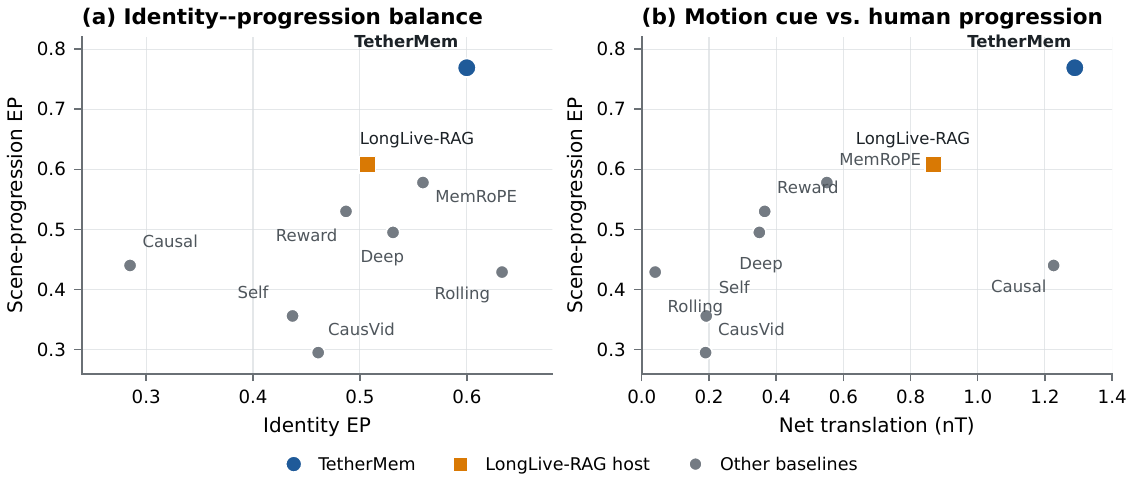
Human preference distinguishes coherent scene development from raw motion. TetherMem occupies the high-identity, high-progression region, while strong motion alone is not sufficient.

Qualitative trajectories
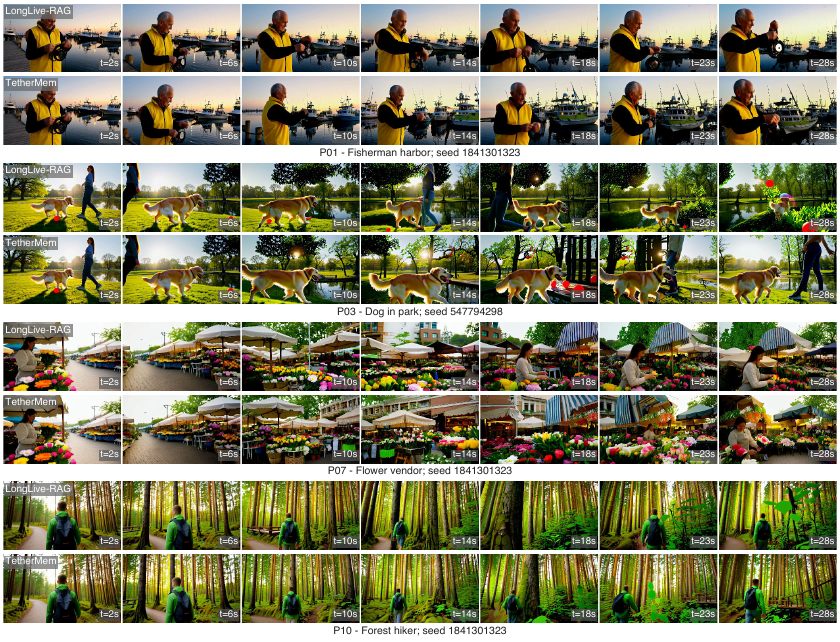
Matched trajectories sample the same backbone pair across multiple prompts and seven timestamps over the 30-second evaluation window.

@article{li2026tethermem,
title = {Tether the Subject, Release the Scene:
Query-Aware Memory Routing for Long-Horizon
Autoregressive Video Generation},
author = {Li, Chen and Zhang, Peng and Zhou, Hanyu and
Zuo, Jialong and Wang, Fei and Zhou, Daiguo and
Sang, Nong and Gao, Changxin},
year = {2026},
eprint = {2608.26902},
archivePrefix = {arXiv},
primaryClass = {cs.CV},
url = {https://arxiv.org/abs/2608.26902}
}